Are we truly honoring Masonic tradition or simply engaging in the unthinking repetition of ritual? This provocative inquiry challenges the customs we take for granted, arguing that the future relevance of Freemasonry depends on its members becoming more contemplative and questioning Masons. Uncover the crucial distinction between mere habit and the Craft's genuine, enduring legacy.
Dealing with Masonic tradition is a complex subject that requires careful analysis in order to reach a balanced point on the best etymological definition and the set of discourses and practices, which often end up being presented as such, without, however, presenting bases that support them, often serving only as a discourse that restricts and controls the masses.
Is a Masonic Tradition Necessary?
Etymologically, the word tradition has its origin in the Latin “tradere”, which means to transmit, pass on to others, give to keep (Mateus, 2013, p. 28).
In practical terms, tradition is understood as a set of symbolic systems that are passed from generation to generation and that have a repetitive character (Luvizotto, 2010, p. 65).
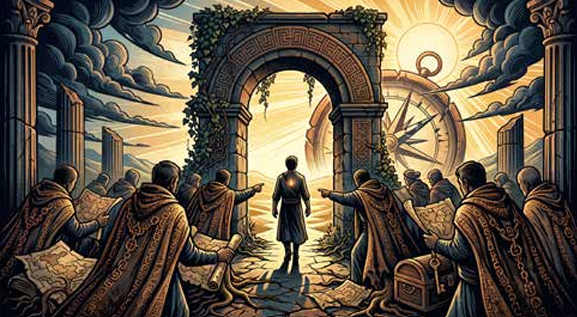
In sociology, Edward Shils referred to tradition as a guiding pattern, a form of knowledge transmitted between generations, subject to some mutations. (Shils, 1981, p. 12)
In the words of Giddens (1997, p. 81), tradition is linked to memory, specifically what Maurice Halbwachs calls “collective memory”; it involves ritual; it is linked to what we will call the formulaic notion of truth; it has “guardians”; and, contrary to custom, it has a force that combines moral and emotional content.
It should be noted that every tradition is essentially exclusive. Only the initiated, the admitted, that is, those who are part of the group, the we, can participate and share its truth, its ritual. (Luvizotto, 2010, p. 69).
Marginalization, discrimination against those who are not initiated, therefore, the other (them), is fundamental to strengthen the status of the guardian, the one who holds the power to transmit the tradition and the ritual itself.
The other is outside, formulaic truth is confiscated. (Silva, 2005 apud Luvizotto, 2010, p. 69).Every social organization advocates for itself a tradition, which usually refers to a distant past, as for example in the various religious matrices and also in institutions such as Freemasonry.
It is not uncommon materials that point to the Masonic tradition as having its bases in remote times, as coming from the Egyptians, Greeks or Hebrews, and even mythological, as originating in the Garden of Eden.
The fact is that regardless of the argument, whether based on historical, mythological, occult or romantic accounts, tradition is an important instrument for Freemasonry, which justifies it up to the present time through this pillar, but also for Freemasons, who can use it to achieve various positive as well as negative purposes.
For the sociologist Weber (1994), one of the forms of domination in a society is based on tradition, the belief in the sanctity of orders and powers that have always existed, whose content cannot be changed, functioning as the element that unites the social orders. This form of action within Freemasonry, despite appearing timidly at specific times, is effective for those who have the discourse in their favor.
However, the use of tradition as a form of domination is an anti-Masonic practice, going against the ideal of evolution and intellectual improvement and the pillar of freedom, and also because it resembles practices of tyranny, censorship and restriction of freedom.
It is possible to observe a certain contradiction between those who embrace the argument of tradition, placing it whenever possible in a veiled way above the legislation, since this same tradition presents itself in many moments as problematic, especially in ritualistic practices, almost always outdated and full of errors and execution defects.
Procedures for latecomers, the candidate’s posture at the time of the oath, reception and constitution, circulation in lodge, pronunciation of the ‘words’ in the apprentice degree, are examples of issues overcome, many of which were resolved more than two hundred and fifty years ago, however, in the name of tradition which coincidentally is that of those who are alive and owners of such a discourse, or their peers, they insist on practicing it in the wrong way.
How can a recent tradition, which appears to be problematic, erroneous and sometimes authoritarian, which handles discourse, be treated as reliable?
Such ‘intellectuals’ could rely on an ancient historical tradition, basing themselves on ancient rituals, on 18th century expositions or on Old Charges, as these materials truly point us to the various Masonic traditions, rather than a recent, received, erroneously reproduced tradition by these ‘intellectuals’.
They could even rely on the observations of Hobsbawm and Ranger (1997), when they state that “every tradition is an invention that arose somewhere in the past, and can be changed somewhere in the future”, but that would certainly be inferring too much liberalism or progressivism, a problem for such minds.
The argument from tradition can also go beyond the ritualistic aspect and reach the aspect of morality, even though this is subjective within the doctrinal scope of Freemasonry. It is absurd to make it necessary to remember that Freemasonry is not a religion. In this context, censorship attempts may occur on the debate of certain subjects that do not please the group “holder” of the tradition, so that the tradition begins to assume greater authority than the laws and Masonic freedom.
This absurd practice is also presented as anti-Masonic, because within what the laws allow, there are no subjects that should be prohibited or censored by tradition, because, as mentioned, it is not above legislation. Due care must be taken so that this type of attitude does not work as an oppressive and controlling practice, restricting the intellectual freedom of each Freemason, regardless of degree.
In view of this, it is necessary to analyze more and more deeply and in detail what is presented as tradition, especially for the new Freemasons, in order to avoid the dissemination of disinformation ensured by a discourse of authority and supposed discipline, which is shown to be ineffective, out of alignment with the present and the presuppositions of the order, and which often reveals a discourse of censorship and restriction of freedom, central pillars in Freemasonry.
This reflection must be based on reason, through questioning, having as its sole purpose the search for truth, whether in the aspect of social relations or ritualistic.
by Bro. Fernando Rodrigues de SouzaPublished in the August edition of the Lyceum (A Publication of The Committee on Masonic Education - Grand Lodge of Illinois)


